
What European clubs learned about capital structure, and five steps to apply those lessons in the Kingdom…
This was originally published by Alvarez & Marsal.
Ownership has changed. The funding model must do the same.
Saudi Arabia’s top clubs are transitioning from state ownership toward more commercially oriented balance sheets. The Public Investment Fund (PIF) acquired a 75% stake in Al Hilal Saudi Club, Al-Nassr FC, Al-Ittihad Club, and Al-Ahli Saudi FC in 2023, with other clubs transferring to Aramco, NEOM, Diriyah, and the Royal Commission for AlUla1. Successive privatization rounds are now moving those stakes to private investors, and foreign ownership of up to 100% is permitted.
The investment that accompanied the first phase was quite substantial. Saudi Pro League clubs committed more than $1.5 billion in transfer markets from the 2023 boom onward2, funded largely through shareholder support.
In July 2025, the Ministry of Sport introduced financial regulations designed to promote greater financial sustainability in the sector3, and responsibility for finance shifted to the league rather than remaining with the state.
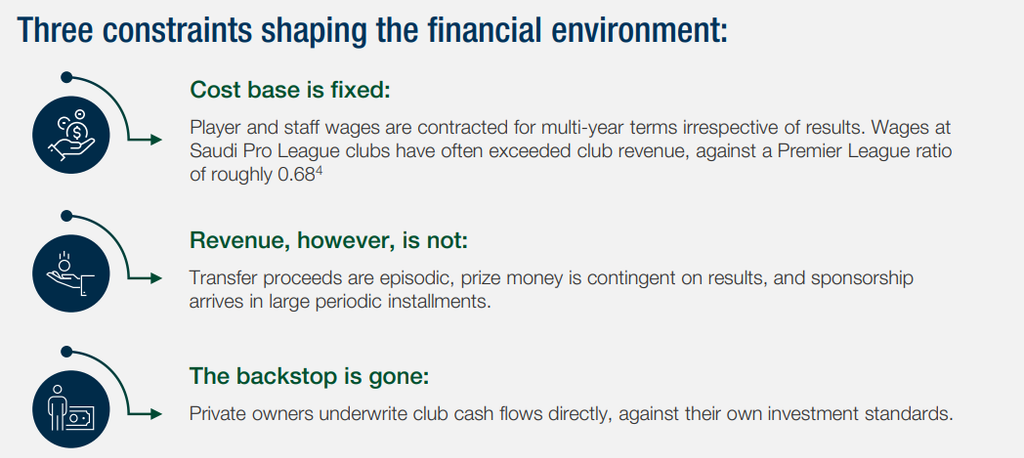
That transition creates a distinct financing challenge: clubs that previously relied on shareholder funding had limited need to develop independent capital structures, whereas clubs required to fund their operations independently must establish appropriate financing strategies. Moreover, the assets that European clubs typically use to secure financing, such as media rights, stadium ownership, and long-term sponsorship contracts, are not yet available at comparable scale in the Kingdom.
The revenue mix in the Kingdom changes what can be financed.
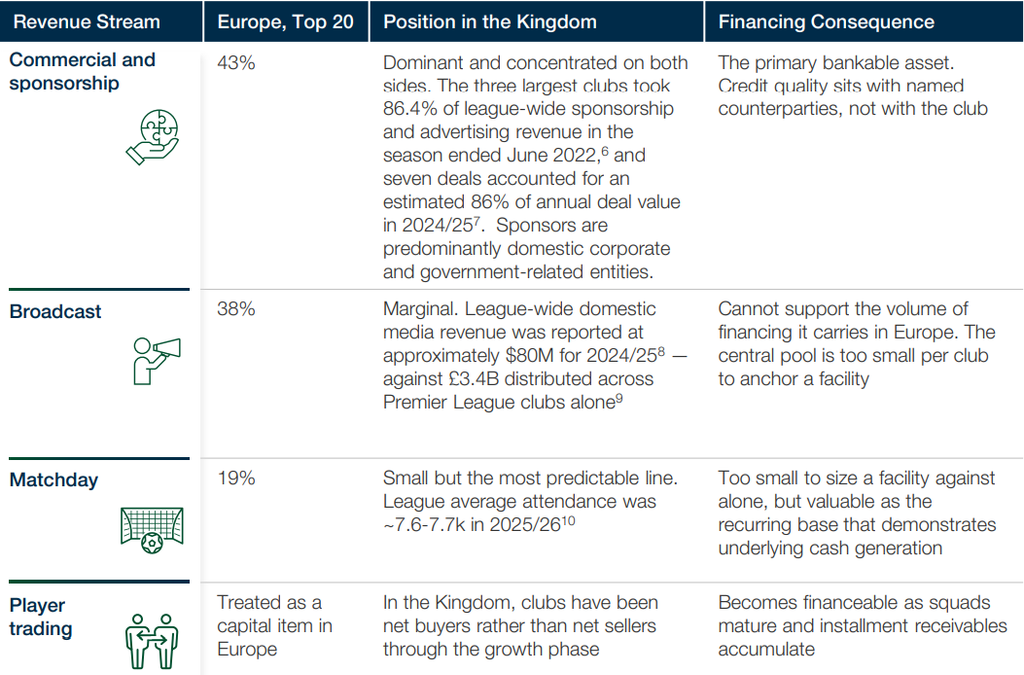
European club financing models are based on a revenue mix that is not currently replicated among Saudi clubs.
Across the twenty highest-earning clubs in world football, revenue in 2024/25 divided into commercial (43%), broadcast
(38%) and matchday (19%)5. In the Kingdom, the revenue mix is more heavily weighted towards commercial and
sponsorship income
How European clubs approach financing:
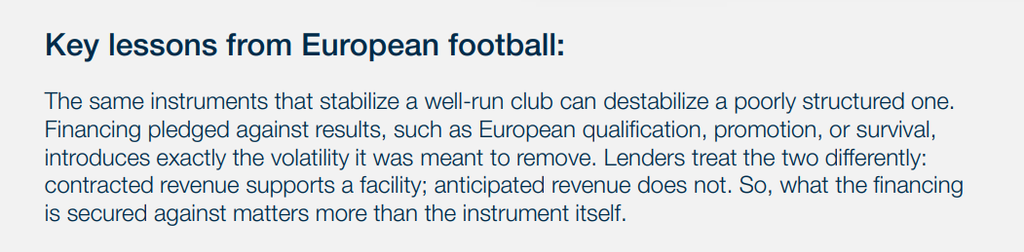
European football has spent two decades building a financing market around volatile revenues. The instruments are well established, the lender base is specialized, and the structures are transferable. Three families of structure account for
most of the market.
Receivables factoring
Raise cash against contracted receivables
Clubs assign future broadcast, sponsorship, or transfer installment receivables to a financier in exchange for cash today. In Italy, Banca Sistema has securitized €1.2B of media rights and transfer receivables11. Rights and Media Funding has extended over £3B to English clubs against broadcast income, and Barclays provided West Ham a £145M facility secured on future television revenue12.
Pricing follows the obligor’s credit, not the club’s.
Asset-secured term debt
Borrow long against what does not move
Stadiums, training facilities, and naming rights support term borrowing at tenors matched to asset lives. Apollo lent Nottingham Forest approximately £80M secured against the City Ground at 8.75% over three years13; Everton refinanced its stadium borrowing in March 2025 with a £350m private placement of senior secured notes, co-issued by two stadium subsidiaries and placed by JPMorgan with institutional lenders14. These assets hold value irrespective of sporting results, which is precisely why lenders accept them.
Collateral that can retain value across sporting cycles.
Squad and working capital
Fund the gap between wages and receipts
Revolving facilities sized against recurring income bridge the gap between a fixed monthly wage bill and receipts that arrive in installments. Squad-backed facilities allow borrowing against the playing squad with controls over how future transfer receipts are applied15. The discipline is that the facility exists before it is needed.
Liquidity planned in advance can provide greater flexibility.
Five steps to a financeable Saudi club:
The instruments transfer. The sequence is what determines whether a club reaches terms worth having because each step depends on the one before it.
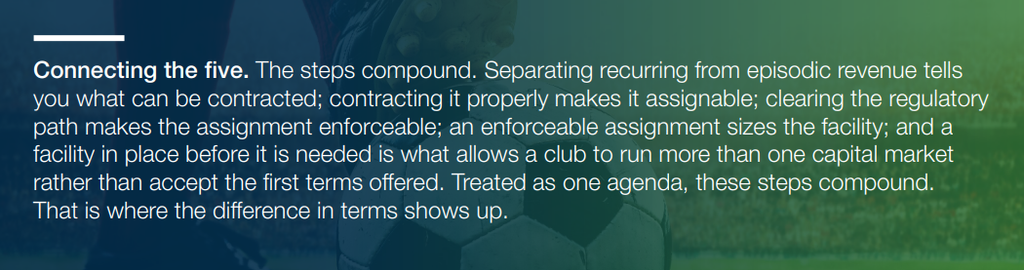
1. Separate the recurring from the episodic
Before any structuring conversation, rebuild the P&L around cash behavior rather than accounting category. Contracted sponsorship, central distributions, and season ticket income are one class. Transfer proceeds, prize money, and one-off commercial events are another. Most club reporting mixes them, which is why owners see a growing top line and still face a liquidity question every quarter. Lenders will perform the same exercise. Doing it first means the club presents its own numbers rather than responding to someone else’s.
2. Contract the revenue before financing it
A sponsorship agreement is not automatically bankable. Term length, payment schedule, termination rights, performance conditions, and assignability determine whether it is treated as revenue or as collateral. Renegotiating a three-year deal into a five year deal with defined escalation and a fixed payment calendar can be worth more than the headline increases in value. Where renewals are clustered, stagger them; concentration of renewal dates is itself a credit issue.
3. Clear the regulatory path early
Receivables structures depend on the club’s right to assign. In England, Football Association (FA) and league rules largely confine the assignment of transfer-fee receivables, and in the Premier League central distributions, to UK-incorporated banks. FIFA’s transfer regulations, mirrored domestically by the FA, separately prohibit third-party ownership of players’ economic rights and third-party influence over clubs’ employment and transfer decisions.16 Saudi clubs face the equivalent questions under league financial regulations and AFC licensing. Establishing what can be assigned, to whom, and with whose consent is best addressed at the outset, where it costs nothing, rather than in documentation, where it costs time.
4. Build the facility before the need
A committed working capital facility sized against recurring revenue is typically the least expensive committed money available to a club, yet it is the one most often arranged late. Its purpose is to remove the link between the wage calendar and the sponsorship payment calendar, so that neither a delayed installment nor a quiet transfer window forces a decision. Conventional revolving or tawarruq formats both work; the discipline is arranging it while the club is in a position of strength.
5. Run more than one capital market
Local banks, regional banks, private credit funds, and the sukuk market price club risk very differently. Private credit can accommodate a different risk profile than traditional bank lending, and it can move faster; banks price contracted receivables more finely. Sukuk reaches domestic insurance and pension money, and family offices that sit outside the bank market entirely. Running these in parallel is the least expensive form of price discovery available, and the competitive tension it creates is often worth more than any single term negotiated in isolation.
Looking ahead: Saudi Arabia as a global talent hub.
Saudi clubs already compete with the world’s best. Al Hilal Saudi Club beat Manchester City at the 2025 FIFA Club
World Cup, and Al-Ahli Saudi FC won the 2025 AFC Champions League Elite17.
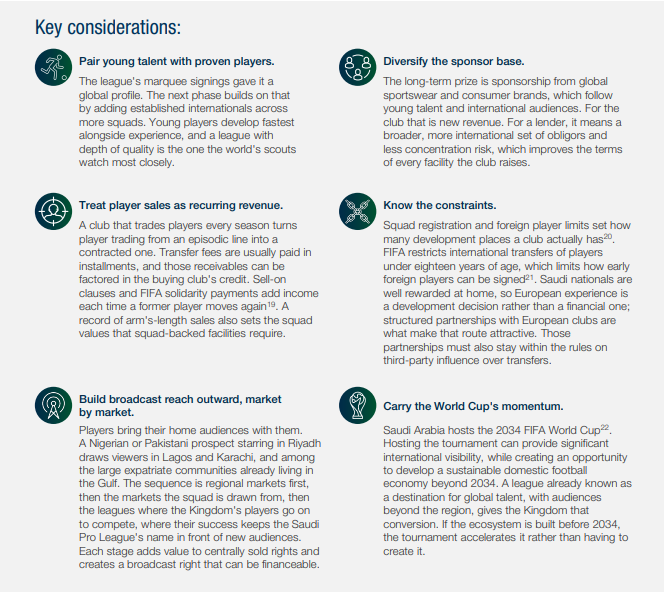
The five steps above make a Saudi club financeable on the revenue it has today. The larger opportunity is in revenue streams the clubs have not yet built. Sponsorship receivables will underwrite facilities today for Saudi clubs, but they remain largely dependent on a relatively small market. The next phase of growth depends on revenue beyond the domestic sponsor base, and the strongest source is a league that attracts talent from around the world, develops it, and gives it a global stage
Saudi Arabia has the potential to become both a destination for established talent and a platform for developing emerging talent. The league has already shown it can attract the world’s best-known players. It can also become the place where the next generation is found and developed, the role that keeps Lisbon, Porto, and Amsterdam on the European football map18. Young players from Africa, South Asia, South America, and across the region could develop in the Kingdom, with some building their careers here and others moving on to the world’s top leagues. The world’s leading clubs buy stars and sell talent at the same time. The two models can be complementary.
- https://www.pif.gov.sa/-/media/project/pif-corporate/pif-corporate-site/our-financials/annual-reports/pdf/pif-2023-annual-report-en.pdf
- https://www.reuters.com/sports/soccer/new-financial-regulations-will-ensure-sustainability-saudi-pro-league-says-ceo-2025-08-28/
- https://www.reuters.com/sports/soccer/new-financial-regulations-will-ensure-sustainability-saudi-pro-league-says-ceo-2025-08-28/
- https://www.consultavalon.com/wp-content/uploads/articles/3327.pdf
- “Deloitte Football Money League 2026,” Deloitte, January 22, 2026 (2024/25 season; commercial €5.3bn, broadcast €4.7bn, matchday €2.4bn of
€12.4bn total). - “Revenue of Saudi Professional League clubs hits SR455 million,” Saudi Gazette, September 2022, reporting Al-Eqtisadiah. Covers 15 clubs; AlAhli, then in the first division, did not publish results for that season.
- https://www.globaldata.com/media/sport/2024-25-saudi-pro-league-generate-estimated-54-53-million-sponsorship-revenue-reveals-globaldata/
- https://www.globaldata.com/media/sport/2024-25-saudi-pro-league-generate-estimated-54-53-million-sponsorship-revenue-reveals-globaldata/
- “Annual Review of Football Finance: Premier League Clubs,” Deloitte, July 2026.
- 2025/26 Saudi Pro League season records (2.3m total attendance across 302 matches).
- “Banca Sistema completes the first securitization in Italy in the football sector, purchasing €1.2 billion in loans,” Millano Finanza, June 2025.
- https://theesk.org/2025/08/02/the-analysis-series-an-analysis-of-lenders-debt-and-influence-in-english-and-european-football/
- “Apollo lends £80mn in pricey debt to Premier League’s Nottingham Forest,” Financial Times.o read
- “Everton secure £350 million financing deal for new stadium,” ESPN, March 2025.
- “The money game: debt financing in football,” Farrer & Co.
- “Understanding debt finance in football: debt factoring and secured loans,” Farrer & Co, June 2025.
- FIFA Club World Cup 2025, Round of 16: Al Hilal 4–3 Manchester City (aet), Orlando, June 30, 2025; AFC Champions League Elite 2024/25 Final:
Al Ahli 2–0 Kawasaki Frontale, Jeddah, May 3, 2025. - https://football-observatory.com/Transfer-system-and-the-Premier-League
- FIFA Regulations on the Status and Transfer of Players, Article 19 (protection of minors) and Annexe 5 (solidarity mechanism).
- SPL Handbook 2025-26 (Saudi Pro League foreign player registration rules)
- FIFA Regulations on the Status and Transfer of Players, Article 19 (protection of minors) and Annexe 5 (solidarity mechanism).
- https://inside.fifa.com/tournament-organisation/world-cup-2034