Attracting equity will depend on the bankability and overall investment position of each development package
This was originally published by Alvarez & Marsal.
Ownership has changed. The funding model must do the same.
Saudi Arabia’s top clubs are transitioning from state ownership toward more commercially oriented balance sheets. The Public Investment Fund (PIF) acquired a 75% stake in Al Hilal Saudi Club, Al-Nassr FC, Al-Ittihad Club, and Al-Ahli Saudi FC in 2023, with other clubs transferring to Aramco, NEOM, Diriyah, and the Royal Commission for AlUla1. Successive privatization rounds are now moving those stakes to private investors, and foreign ownership of up to 100% is permitted.
The investment that accompanied the first phase was quite substantial. Saudi Pro League clubs committed more than $1.5 billion in transfer markets from the 2023 boom onward2, fSaudi Arabia’s ambitious development agenda continues to create significant investment opportunities across real estate, tourism, hospitality, and infrastructure. As the Kingdom advances its Vision 2030 objectives, project sponsors face an evolving financing environment characterized by growing competition for third-party capital and greater scrutiny of project economics.
Most development funding plans in Saudi Arabia assume that a joint venture (JV) will provide the required capital. This approach faces challenges because the available third-party development equity may be insufficient to meet the funding requirements of the project pipeline. The Public Investment Fund’s 2026–2030 strategy emphasizes attracting private-sector capital and reducing portfolio companies’ dependence on state funding. Slow growth in foreign direct investment (FDI) adds urgency to these priorities.1 At the PIF Private Sector Forum in February, the fund and its 120 portfolio companies pitched to investors and suppliers; organizers expected the event to produce more than a hundred memoranda of understanding.2 The greater challenge is converting these memoranda of understanding (MoUs) into funded equity commitments.
The sponsor side of the equation has tightened at the same time. Bloomberg reported in November 2024 that PIF had asked some portfolio companies to reduce proposed budgets by as much as 20%, while the fund’s position is that overall capital deployment continues to increase.3 Construction contract awards fell from roughly $71 billion in 2024 to under $30 billion in 2025, and PIF’s share of national awards dropped from 38% to 14%.4
The underlying demand drivers remain in place. Vision 2030 still targets 70% homeownership among Saudi citizens, up from 65.4% at end-2024,5 and 150 million annual visits by 2030, against an estimated 122 million in 2025.6 Foreign ownership caps were removed with effect from January 2026.7 Expo 2030 and the 2034 FIFA World Cup establish fixed delivery timelines. Credit availability also remains significant: S&P expects Saudi banks to extend $65–75 billion in new corporate loans in 2026, led by real estate and utilities.8 Outstanding real estate loans stood at approximately SAR 965 billion ($257.3 billion) in late 2025.9 The listed Saudi REIT market runs to roughly SAR 14.6 billion ($3.9 billion) across 19 vehicles,10 and real estate funds and regional private credit are both scaling into development finance.11
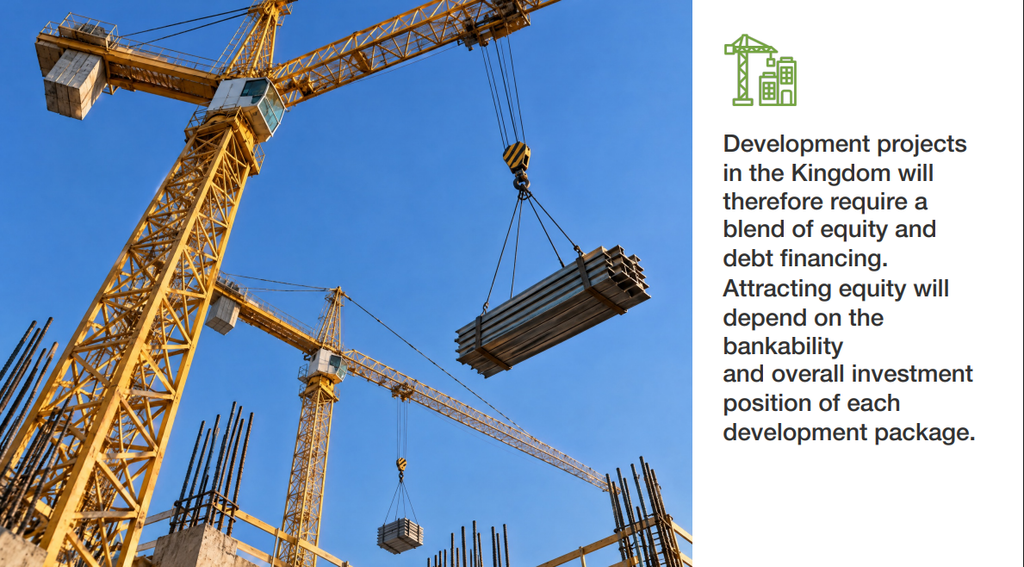
Attracting Equity in a Finite Market
Third -party development equity in the Kingdom is limited, with multiple projects in the pipeline are competing for it at the same time. A sponsor’s package is not measured against a hurdle rate alone; it is measured against every other package in the market competing for the same cheque.
Investor expectations have also shifted. Investors have become more selective about giga-project exposure,12 and the PIF has reprioritized parts of its portfolio in parallel.
PIF has demonstrated the ability to widen the investor pool. The fund is seeking GCC sovereign co-investors, Asian institutional partners, and international private equity investors through project structures offering clearer governance and exit terms than earlier giga-project arrangements.13 These investors will continue to evaluate Saudi opportunities against regional and global alternatives.
Saudi real estate projects must offer competitive risk -adjusted returns relative to regional and global investment opportunities. Debt capacity is an important consideration in this assessment, as the availability of construction financing can influence the equity contribution required from investors and their potential returns.
Debt Capacity Is Critical To Attracting Equity.
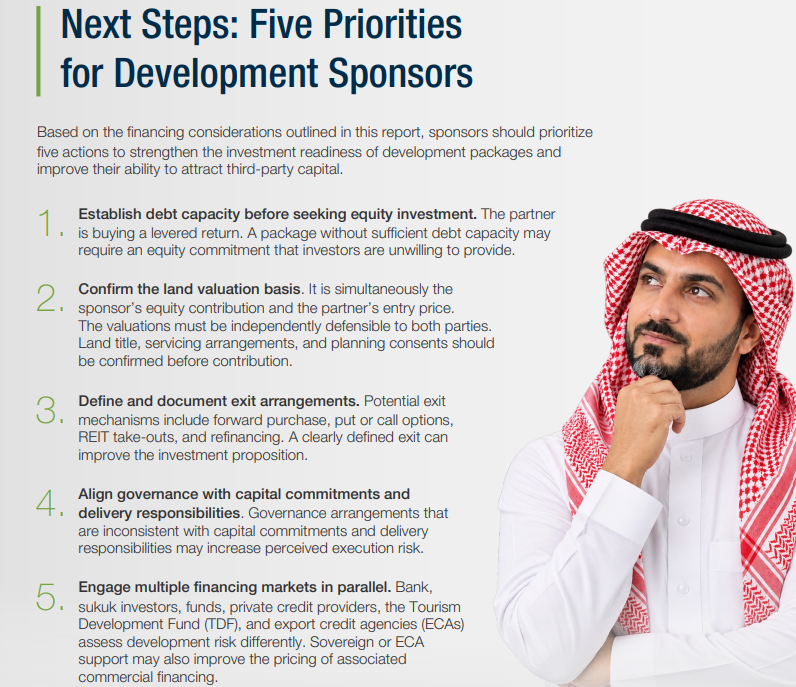
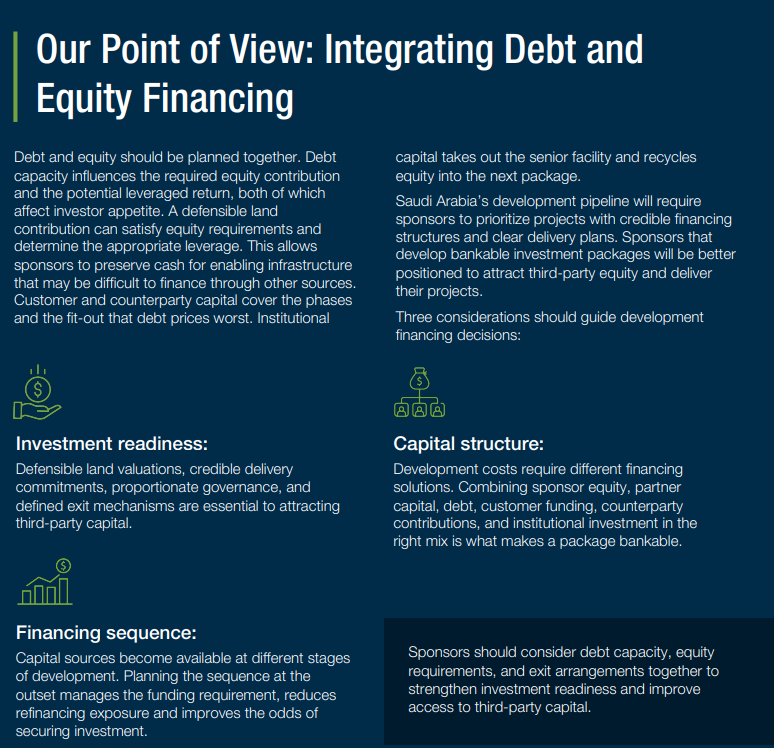
The availability of leverage can materially influence an investment partner’s returns. A development package supported by construction financing equivalent to 60–70% of project cost may require a smaller equity contribution and offer returns that meet institutional investment requirements. Without debt financing, the same package would require an equity contribution two to three times larger while offering a lower unlevered return. This could make the investment commercially unattractive to potential partners.
Sponsors should prioritize the bankability of development packages to improve their prospects of attracting third -party equity.
Making The Package Investable
Attracting third-party capital requires sponsors to demonstrate that development packages are commercially viable and appropriately structured. Investors assess a combination of financial, operational, and governance considerations to determine whether the anticipated returns adequately reflect the underlying risks.
Six factors are particularly relevant to this assessment covering land valuation, delivery commitments, exit mechanisms, governance, asset composition, and development-package structure.
1. Is the land valuation commercially defensible?
Land valuation is often a determining factor in whether a transaction proceeds.
Land contributed at fair market value can satisfy the 30–40% equity requirement for a construction facility financing 60–70% of project cost. This can make land the sponsor’s most efficient equity contribution. On a SAR 1 billion package with SAR 400 million of land, it reduces the sponsor’s cash requirement from SAR 600 million to close to nil.
The valuation basis also determines the partner’s entry price. Land marked aggressively transfers the full development uplift to the sponsor and leaves the partner with a residual margin that does not clear a hurdle rate. This may discourage potential partners from investing or create disagreements during subsequent project decisions.
The valuation must be independently defensible to both lenders and partners. Land title, servicing status, and planning consent must also be confirmed at the point of contribution. Sponsors who leave those unresolved find the land discounted at exactly the moment they need it to carry the equity test.
2. Can the sponsor meet its land delivery commitments?
Master-developer delivery obligations can be a significant consideration in investment decisions, alongside project pricing and anticipated returns. Sponsors must deliver serviced plots by an agreed date, ensure utility connections are operational, and complete access infrastructure. If a partner’s construction program depends on infrastructure that the sponsor has not funded, the partner will factor this risk into its investment terms.
Liquidated damages in these structures generally run only against the contractor. Where the sponsor carries delivery obligations, they should run against the sponsor too, sized against the partner’s debt service and lost revenue during the delay period.
3. Is there a clearly defined exit strategy?
A clearly defined exit strategy is an important consideration for investors evaluating development risk. Potential exit mechanisms include forward purchase at practical completion, put or call options at a predetermined price, a REIT take-out at stabilization, or refinancing that releases equity. A CMA-regulated development fund may become more attractive to investors when a specialized listed REIT is committed to purchasing the stabilized assets. The exit is what makes the entry investable, and it should be documented at signing rather than discussed at completion.
The exit terms should also establish how the price will be determined. Agreeing a pricing formula at signing, based on a stabilized yield or cost plus an agreed margin, gives both parties clarity and reduces the scope for negotiations when bargaining power may be uneven. Where the partner has the right to sell its interest back to the sponsor, it will also assess the sponsor’s ability to meet that commitment and factor this credit risk into its required return.
4. Does governance reflect the allocation of capital and risk?
Sponsors often retain approval rights over design, procurement, leasing, pricing, and disposal while expecting partners to provide most of the capital. Reserved matters should be limited to what genuinely protects the masterplan: land use, design code, phasing interfaces, brand standards. Other decision-making rights should generally rest with the party bearing the capital commitment and delivery risk. Governance arrangements that are inconsistent with capital commitments and delivery responsibilities may increase perceived execution risk and influence investment terms.
5. Can low-return assets be integrated into a bankable development package?
Convention centers, arenas, and core infrastructure may be difficult to finance independently because of low returns and limited contracted cash flows. Combining these assets with hotels, residential developments, retail facilities, and associated commercial rights can make the same assets more financeable. Lower-return anchor assets often generate the footfall, density and development rights that everything around it is priced off.
Hong Kong’s MTR provides a relevant international example: development rights are granted at a scale calibrated to the infrastructure funding gap, then tendered to developers with the profit shared.14 Melbourne’s convention center was delivered as a 25-year PPP with the surrounding mixed-use precinct bundled into the same award.15 Expo City Dubai brought Aldar in on a 50:50 JV with a GDV above AED 1.75 billion.16
6. Is the development package appropriately structured for investors?
Ring-fence financing at the development-package level. Plot-by-plot financing is unmanageable at volume; HoldCo-level financing defeats the cash flow and risk ring-fencing a partner is paying for. The financeable unit is a set of adjacent plots owned, developed, financed and operated through a dedicated SPV.
Define package boundaries based on financing requirements and investment characteristics. Consider development timing, plot adjacency, a unified development strategy, the target investor base, and the overall risk-return profile. Then stagger the raises so bank and equity capacity can recycle between packages. Bringing the entire development pipeline to market simultaneously increases competition for same available capital and place pressure on financing terms.
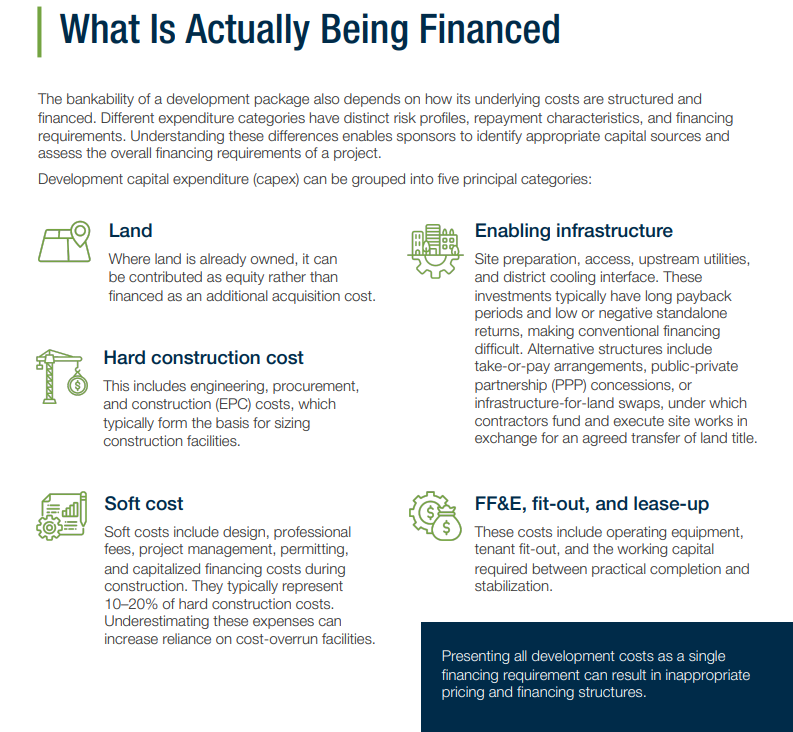
Six Sources Of Development Capital
Development projects can draw on multiple sources of capital, each with different financing characteristics, costs, and availability across the project lifecycle. Combining these sources can help sponsors align financing arrangements with specific development requirements and manage their overall capital commitments.
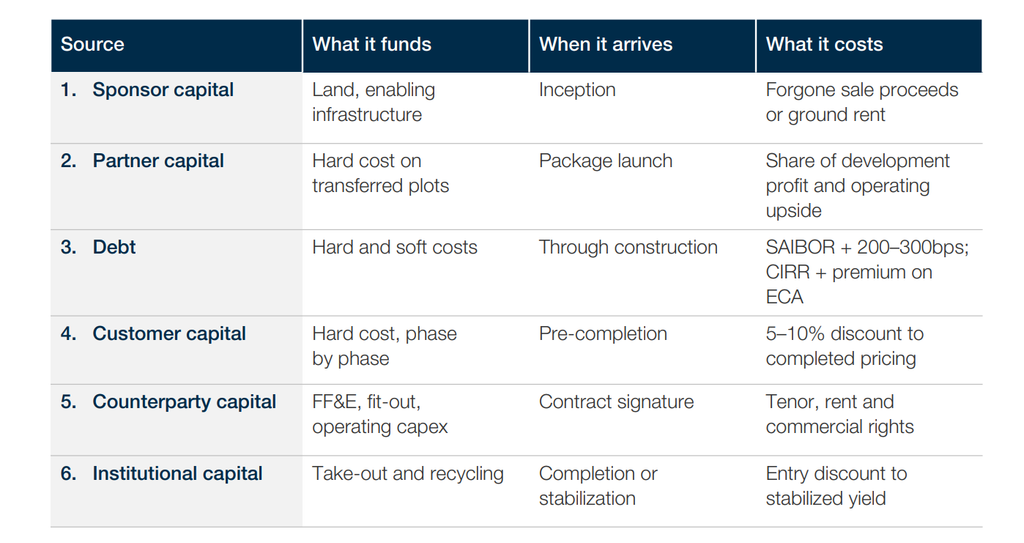
The following table summarizes six potential sources of development capital and their respective applications.
1. Sponsor Capital
Sponsor capital funds the two components that other capital providers are generally unwilling to finance at inception: the land and the enabling infrastructure. Neither requires a cash outlay, which is why both are routinely carried at zero cost. However, both carry an economic cost. Land contributed in kind carries an opportunity cost equivalent to the value the sponsor could have realized through a sale or ground lease. This forgone value should be reflected in the package return rather than treated as a sunk endowment.
Enabling infrastructure presents a greater financing challenge. Site preparation, access and upstream utilities
carry low or negative standalone returns and no contracted cash flow, which puts them beyond conventional project debt and outside most partners’ appetite. As a result, these investments typically require sponsor funding. Before committing capital, sponsors should assess whether alternative structures can address these obligations. A long-term take-or-pay offtake can support a PPP concession for a utility asset. Under an infrastructure-for-land swap, a contractor funds and executes the works in exchange for a pre-agreed transfer of title.
2. Partner Capital
Partner capital can be structured through ground leases, master-developer JVs, or design-build-finance-operate (DBFO) concessions. Under a ground lease, the sponsor retains land ownership and leases developable plots for 25–30 years. The developer funds the construction capex; Singapore’s Tourism Board used this approach at Marina Bay Sands, where the 2019 expansion required a S$1.36 billion payment from the operator without direct government funding.17 New York’s Metropolitan Transportation Authority (MTA) adopted a similar approach at Hudson Yards. It granted a 99-year ground lease over its West Side rail yards, valued at US$1.05 billion in present value. The developer privately financed a platform costing roughly US$2 billion over the operating rail tracks before tower construction began.18 A master-developer JV shares capex and operating upside pro-rata against the land contribution. A DBFO concession allows a consortium to design, build, finance, and operate a low-return anchor asset in exchange for availability payments. This structure is used for infrastructure assets that cannot independently generate sufficient revenue to service commercial debt.
3. Debt
Debt capacity plays a critical role in attracting equity investment.
- Construction finance is the primary debt layer, with typical tenors of three to five years and an availability period of four years. Facilities generally involve pro-rata drawdowns alongside equity, a maximum loan-to-cost (LTC) ratio of around 70%, and pricing around three-month SAIBOR plus 200–300 basis points. The minimum debt service coverage ratio (DSCR) is typically around 1.5x on a sculpted repayment profile. Sponsors should assess development packages against these financing parameters at an early stage.
- A revolving credit facility (RCF), sized against negative cash flow after sales, can bridge the time lag between contractor payments and escrow releases without capitalizing the funding gap into the term facility.
- The Tourism Development Fund, capitalized at SAR 15 billion, co-invests through senior and subordinated debt, direct equity and loan guarantees issued alongside commercial banks, explicitly to improve bankability on qualifying hospitality assets.19 Most of the value sits in what the guarantee does to the pricing of the commercial tranche beside it
- ECA-backed buyer and supplier credit runs to 10–15 year tenors and reallocates country and political risk to sovereign -backed agencies. UK Export Finance (UKEF) buyer credit can support up to 85% of the contract value, subject to eligibility. OECD-supported financing is priced using the Commercial Interest Reference Rate (CIRR), plus a risk premium. The CIRR is the minimum rate for officially supported export credits and is set monthly for each currency. DEWA’s 2009 multi-ECA financing brought SACE, Coface and Euler Hermes into a single US$1.3 billion framework at a 13-year tenor.20 In July 2024, ADNOC signed a US$3 billion green facility with JBIC, partly co-financed by Japanese commercial banks.21
- Private credit will underwrite construction and lease-up risk that conventional bank credit committees may not. Engaging private credit providers alongside banks can support competitive pricing and broader financing options.
Project finance and project sukuk should be evaluated against the underlying development risk and cash flow profile. Non -recourse project finance sizes debt on contracted cash flow; rental income depends on lease -up and is cyclical. Sukuk investors prefer income -producing assets with established cash flows, compared to four years of capitalized profit.. Both structures may be more suitable for refinancing once assets have been stabilized. At that stage, sukuk may reach the domestic insurers, pension funds and family offices that the banking market misses
4. Customer Capital
Pre-sales are development financing, and they are the source most often mistaken for sales. A 300-key hotel development could be structured as a 200-key hotel alongside 100 branded residences. Pre-sales of the residences could generate funding for the hotel and associated anchor assets. The number of luxury hotels with branded residential components tripled between 2015 and 2025.22 Under the Off-Plan Sale and Lease Law, effective April 2024, receipts are held in project-specific escrow accounts and released against milestones. Reservation fees are capped at 5% of unit value, and the law also establishes a statutory minimum for delay compensation.23 Proceeds arrive at a 5–10% discount to completed pricing. The discount should be assessed as a cost of capital relative to the financing facility it replaces. Sales velocity should also be stress-tested against market conditions: new residential mortgage volumes fell to SAR 4.4 billion in May 2026 from SAR 9.96 billion a year earlier.24
5. Counterparty Capital
Counterparty capital is often negotiated as part of commercial agreements without being explicitly evaluated as a financing source. Operator key money typically ranges from 3–7% of total project cost, or US$5,000–20,000 per key. It is amortized over the hotel management agreement term and may be forfeited upon early termination. The associated financing cost is reflected in the agreement’s duration and contractual flexibility. Anchor F&B and retail tenants fund their own fit-out against a long lease where the landlord delivers shell and core only. Naming rights carry a fee over 15–20 years. Alternatively, payments can be structured as loans. SoFi Stadium’s naming rights agreement is valued at approximately US$400 million over 20 years and the MXN 2.1 billion agreement associated with Estadio Azteca’s renaming was structured as a 12-year loan to finance renovations.25 Incremental GFA, height, or density granted to developers of adjacent parcels should be priced against the infrastructure funding gap, not against comparable land values.
5. Institutional Capital
Institutional capital can provide an exit mechanism that can improve the bankability of earlier financing arrangements. Planning for institutional investment at completion or stabilization can improve the bankability of earlier financing arrangements. Under a forward-funding structure, an investor acquires ownership of the special purpose vehicle (SPV) at signing. The investor then funds construction through staged drawdowns against a fixed forward price, assuming construction risk in exchange for a below-market entry price. A forward-purchase agreement establishes an exit before construction begins and may improve construction financing terms. Sale-and-leaseback arrangements can release capital for subsequent development phases. A capped sponsor income or yield guarantee lasting two to three years may also help bridge valuation differences.
Six Sources Of Development Capital
Each financing source is available at a specific stage of development. Missing the appropriate funding window may increase financing costs.
Land equity is committed at inception. Partner capital prices at package launch, when the masterplan is credible and the plots are serviced. Construction debt draws through the build alongside equity. Customer capital arrives only once the off-plan license is in place, and the first phase is visibly underway. Counterparty capital is fixed at contract signature, usually well before the finance function is consulted. Institutional capital prices at or near completion.
Construction facilities typically amortize during development or are refinanced upon completion. The refinancing strategy should therefore be established when the original facility is signed. Sponsors should therefore identify the take-out options before entering the initial senior financing arrangement.
- “Exclusive: Saudi wealth fund takes its capital pitch to Wall Street,” Semafor, September 8, 2026
- “Saudi to test revised PIF strategy as giga-project funding tightens,” AGBI, February 13, 2026
- “Saudi Fund’s Shifting Focus Hits Budgets on Some Projects,” Bloomberg, 29 November 2024
- “Saudi 2026 Budget: No NEOM, No Mukaab, $44B Deficit, Megaprojects Defunded,” Vision2030.ai, April 18, 2026; Saudi Construction Contract Awards Surge Despite Less Reliance on the PIF (https://www.mepmiddleeast.com/news/saudicontract-awards-surge-less-pif)
- Housing Program, Saudi Vision 2030 (vision2030.gov.sa); “Housing Program Annual Report 2024,” Ministry of Municipalities and Housing, September 4, 2025
- Ministry of Tourism, Kingdom of Saudi Arabia (target raised from 100 million to 150 million after the original goal was met in 2023); “Saudi Arabia nears 2030 tourism target,” Arab News, January 2026 (2025 figure preliminary)
- “GCC real estate: cross-border capital and market data,” GRI Institute, April 1, 2026
- “Saudi banks seen to maintain strong lending growth: S&P,” Argaam, January 24, 2026
- “Making Homes Affordable across Saudi Arabia by Transforming Housing Finance,” IFC, April 27, 2026
- S&P Global; Tadawul
- “Saudi real estate funds emerge as financing tool for developers,” AGBI, August 2026; “From 2025 Outcomes to 2026 Priorities: A GCC Real Estate Playbook for Institutional Capital,” King & Spalding
- “Saudi Arabia plans to refocus $925 billion fund after gigaproject delays, source says,” Reuters, October 29, 2025; “Investors welcome Saudi giga-project cuts,” AGBI, January 2026
- “Inside Saudi PIF’s New 2026-2030 Strategy,” The Middle East Insider, May 19, 2026
- MTR Corporation Limited, “Announcement of Audited Results for the Year Ended 31 December 2025” (HKEXnews, 12 March 2026); HKSAR Transport and Housing Bureau, “LCQ6: MTR property development,” Legislative Council reply, 25 April 2012
- Victorian Department of Treasury and Finance, “Melbourne Convention Centre Development” project page; Victorian Auditor General’s Office, “Audits of 2 Major Partnerships Victoria Projects” (2007)
- Aldar Properties, “Aldar partners with Expo City Dubai to create major mixed-use development within new Expo City master plan,” press release, 10 October 2024
- Las Vegas Sands Corp. Development Agreement, SEC Exhibit 10.1 (3 April 2019)
- “New York MTA Announces Deal to Develop Hudson Yards,” The Bond Buyer, May 20, 2008
- Jones Day, “Saudi Arabia’s New Tourism Development Fund” (September 2020), citing the Ministry of Tourism announcement of 21 June 2020 and the Tourism Development Fund Law; “Saudi Arabia’s Tourism Development Fund eyes global bank partnerships to boost financing,” Arab News, 13 May 2025
- “Best Deals of 2009: Dewa,” GTR; Citi, “Dubai Electricity and Water Authority (DEWA)” case study
- “ADNOC secures $3bn to advance decarbonisation plan,” AGBI, July 2024
- Savills, “Branded Residences Annual Report 2025/2026”
- “Off Plan Sales in Saudi Arabia: Wafi Rules and Market Data,” Omran Intelligence, July 28, 2026, citing REGA Implementing Regulations, April 2024
- “Saudi lending programme seeks to revive mortgage market,” AGBI, July 14, 2026
- Horwath HTL; (15 February 2026); ESPN (2026)