…A capital structure blueprint for sponsors and CFOs…
This was originally published by Alvarez & Marsal.
Saudi Arabia’s installed data center footprint carries roughly 410 MW of IT load capacity across some 40 operating facilities and is forecast to reach approximately 1 GW by 2030, growing faster than any other market in the region. That forecast, however, is only a fraction of announced ambition.
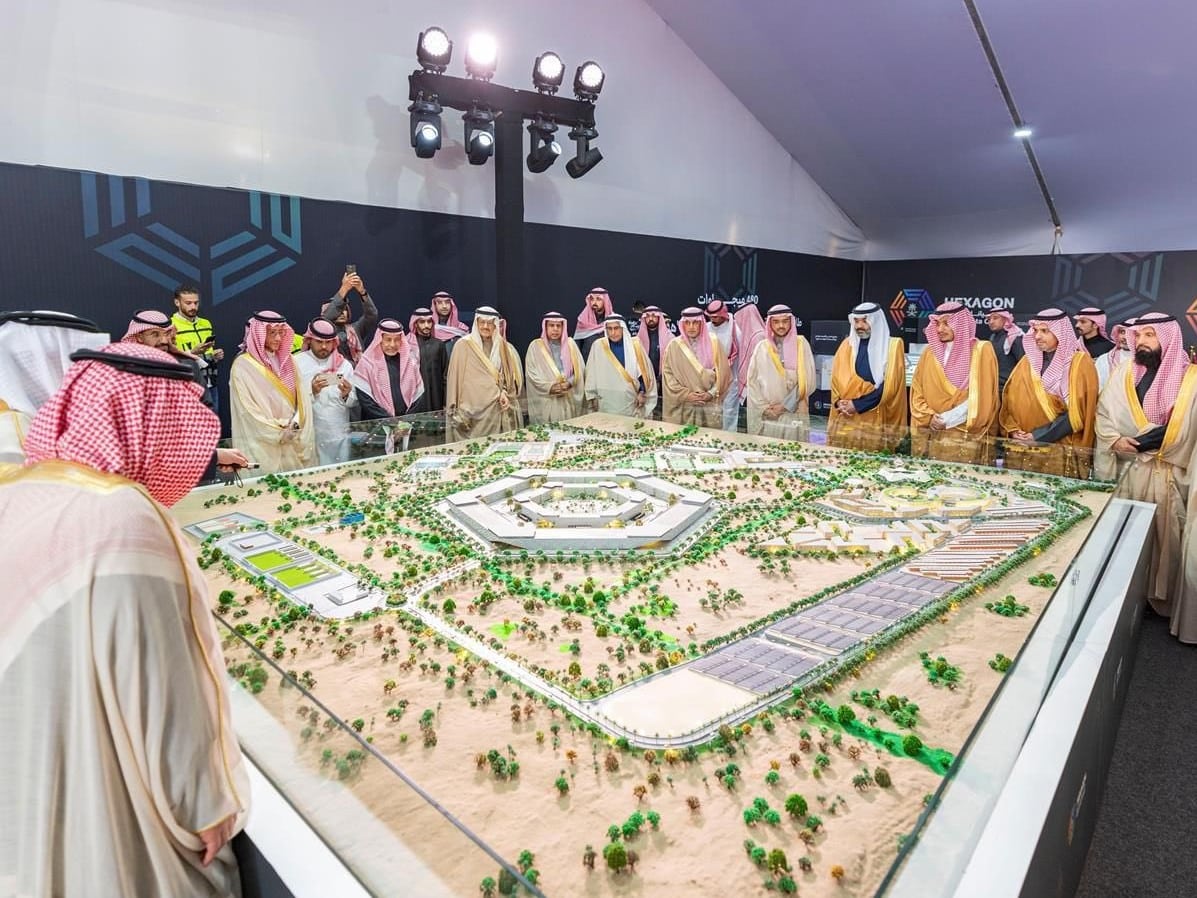
HUMAIN, the Public Investment Fund’s national artificial intelligence company, has been reported as targeting 6.4-6.6 GW of data center capacity over the coming decade, through a combination of its own facilities and leased capacity from other operators1. Its first sites in Riyadh and Dammam each launch at an initial capacity of at least 100 MW2. Its joint venture with stc’s center3, in which HUMAIN holds 51% and center3 holds 49%, begins at 250 MW and targets up to 1 GW3. DataVolt committed $5 billion to a 1.5 GW campus at Oxagon in NEOM. AWS is investing $5.3 billion to develop a new infrastructure region in the Kingdom4. Across the GCC, MEED tracks more than 174 active and planned data center projects with a combined value above $93 billion5.
The demand case is increasingly well established. Three forces underpin it: (1) a cloud-first public sector mandate underpinned by data sovereignty and personal data protection legislation; (2) hyperscalers that increasingly lease rather than build in new markets; and (3) AI workloads whose economics depend on the cost and availability of power, which is a comparative advantage the Kingdom is building its pitch around. On the installed base above, Saudi Arabia carries roughly 12 watts of data center capacity per capita (assuming a population of ~34m).
The UAE, ~510 MW6 against ~10m people, and the United States, at 17.2 GW7 against ~340m, both are close to 50 watts, which is roughly four times the Saudi figure. This level of under penetration, in a market with this much capital behind it, is a build-out waiting to be financed.
Critically, much of the build is a private-sector build. Capacity is increasingly being developed by thirdparty operators and specialist developers—DataVolt, center3, Khazna, ezditek, Sahayeb and others—rather than by the end users consuming it. That shift transfers the balance sheet burden from users to sponsors, and from equity to debt.
Sizing the Capital Call
Two trajectories, two very different financing tasks.
On published benchmarks of approximately $11-14 million per MW of IT load for shell, core and mechanical and electrical plant before any IT hardware8, the capital requirement could be either one of two very different numbers depending on which trajectory the Kingdom follows.
Note that these are global benchmarks; Saudi power costs and construction labor could put the Kingdom at the lower end of that range, and a Kingdom-specific basis should be substituted where available.
- Base case: Growth from roughly 410 MW to approximately 1 GW of IT load by 2030 implies around 620 MW of incremental capacity, or $7-9 billion of project capital. At 50-75% gearing, that is $3.5-7 billion of debt which is less than 1% of Saudi banks’ SAR 3.4 trillion private-sector loan book9, and well inside what the market has absorbed for a single sector before.
- Announced delivery case: If even half of the publicly announced pipeline is energized by 2030—in the order of 2.5-3 GW project capital cost rises to $28-42 billion and the debt requirement to $14-32 billion. Absorbing that would require broader syndication than Saudi banks have previously assembled for this sector and would open real space for institutional capital alongside them.
The difference between these two scenarios highlights the financing challenge. It will not be closed by announcements, land allocation, or power availability, all of which the Kingdom has. It will be closed (or not) on a project-by-project basis, on whether individual assets are structured in a way that debt capital providers can underwrite.
Data center capital is not being raised in isolation. A Vision 2030 project finance pipeline of $100–150 billion is competing for the same lender balance sheets and the same credit committee approvals.
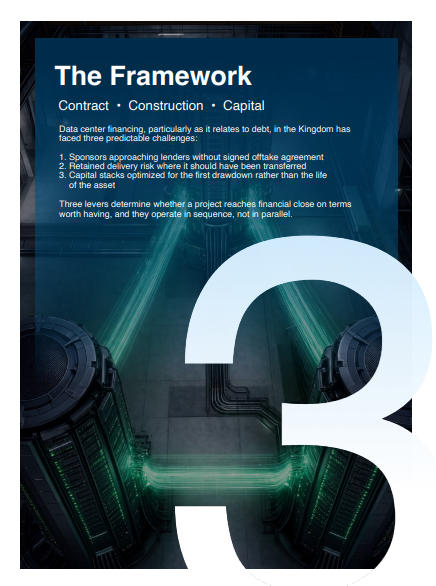
1. Contract
Bankability is a commercial outcome, not a financing one
Lenders primarily underwrite contracted cash flows rather than market forecasts. The Kingdom already offers the proof. DataVolt expects to reach financial close on its approximately $500 million Riyadh East facility after securing HUMAIN as an anchor customer for 36 of the site’s 44 MW, more than 80% of capacity, with banks expected to fund around three quarters of the project cost10. The financing follows once the anchor customer is secured.
- Anchor before you finance: A single investment-grade or sovereign-linked off taker covering 60-80% of Day 1 capacity is the largest single determinant of gearing, tenor and margin. The remaining terms are generally secondary by comparison.
- Size to contracted term: Lenders size to contracted term, not to the renewal assumption in the model. Initial terms of seven years or longer, with defined escalation, convert a merchant asset into an amortizing one.
- Structure the contract as credit: Pass-through power, take-or-pay minimum, termination compensation and step-in rights determine whether a lease is treated as revenue or as collateral. The drafting is worth more than the headline rate per kW.
2. Construction
Risk transferred is risk priced
The overwhelming majority of project cost sits within the EPC scope. Delivery is therefore where sponsors either protect their equity return or quietly surrender it. Lenders will fund construction risk in this market but only where it has been contractually placed with a counterparty capable of bearing it.
- Fixed price, date certain: Liquidated damages should be sized against debt service and lost contracted revenue during the delay period, not against a percentage of contract value chosen for convenience.
- Treat energization as the critical path: Grid connection, not steel, is the binding consideration in the Kingdom. Engagement with Saudi Energy and confirmation of the connection program should be a condition precedent to financial close, not a work-in progress at signing.
- Deploy mechanical and electrical plants in tranches: Phasing mechanical, electrical, and plumbing (MEP) capex against contracted megawatts—rather than building the full design capacity on day one—matches drawdown to offtake, protects the equity return during ramp, and materially reduces the quantum at risk if lease-up slips.
- Certify early: Uptime Institute certification and hyperscaler technical acceptance are diligence gates lenders will wait on. Reaching them late compresses the financing timetable at precisely the wrong moment.
3. Capital
Structure for the life of the asset, not the first drawdown
For sponsors financing data centers in the Kingdom, four structuring decisions determine the cost, tenor, and durability of the capital raised.
- Sequence the stack: A construction facility converts to term debt or a mini-perm at completion, then refinances into longer-tenor institutional paper once the asset is stabilized. Cost of capital falls meaningfully at each step, as the asset moves from speculative to contracted to stabilized. Sponsors who plan that sequence are generally better positioned to capture the benefit, while those who do not may face refinancing under greater pressure.
- Price the balloon on day one: A cover-ratio-driven amortization profile leaves a bullet at maturity which means the refinancing decision is made years before it comes due. Underwrite it accordingly and identify the take-out market before the senior facility is signed.
- Use the sukuk market deliberately: Sukuk suits a leased, asset-heavy project with contracted cash flows, and reaches investors beyond conventional banks—domestic insurance and pension funds as well as family offices among them. Principal is still repaid at maturity, so the balloon discipline above applies here too.
- Run the private credit bid in parallel: International and regional private credit will price construction and ramp risk that bank credit committees will not. Competitive tension between the two markets can be worth 50-100 basis points and a few turns of flexibility on covenants.
Connecting the 3 C’s
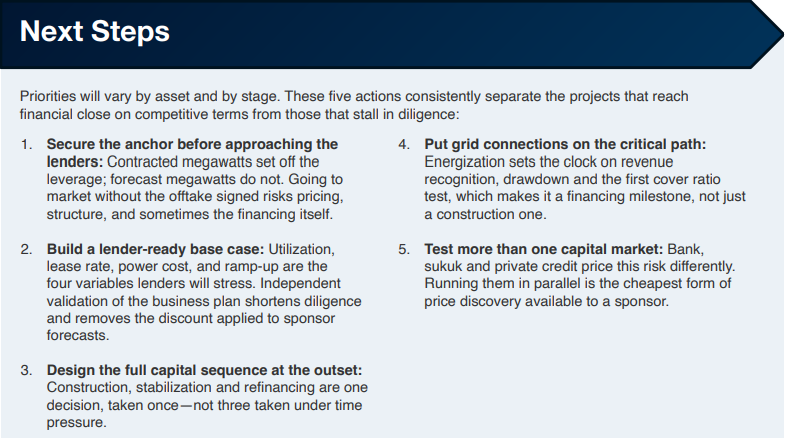
Contract, construction, and capital compound. A stronger offtake supports higher gearing, which shortens the equity cheque; transferred delivery risk supports longer tenor, which lowers annual debt service; a sequenced capital plan turns both into the ability to commit ahead of demand. Sponsors who treat them as one agenda finance better than those who run
them as three.
Saudi Arabia will build the capacity. The open question is who finances it, on what terms, and which sponsors retain their returns through the cycle. Capital is not the constraint. Structuring assets to receive it at this scale is new work in the Kingdom, and the sponsors who do it first will set the terms.
- “Saudi Arabia’s Humain and DataVolt collaborate on data center development,” DCD, November 7, 2025
- “HUMAIN’s Data Centers in Riyadh and Dammam: Are They Open Yet?,” Saudi Vision 2030, July 31, 2026
- “stc and Humain extend deal to build up to 1GW AI data centers in Saudi Arabia,” Fast Company Middle East, June 19, 2026
- “Top 5 New Data Center Projects Middle East 2026 – Latest List,” Blackridge, May 21, 2026
- “MEED Insight Report: The GCC Data Centre Projects Market 2026,” GlobalData, February 16, 2026
- “United Arab Emirates Data Center Market Size & Share Analysis – Growth Trends and Forecast (2026 – 2031),” Mordor Intelligence
- “U.S. Data Center Infrastructure: The Binding Constraint (Mid-2026),” Global Data Center Hub, July 30, 2026
- “Data Center Construction Cost Statistics 2026: Full Breakdown by Type, Region & Driver,” Axis Intelligence Research, June 28, 2026
- “Saudi Arabia’s Bank Lending to Private Sector Reaches SAR 3.43 Trillion,” The Saudi Times. March 18, 2026
- “DataVolt nears USD 500 mn Riyadh financing,” Enterprise AM, June 29, 2026