With U.S. policy in flux, European leaders are signalling Ukraine will not stand alone.
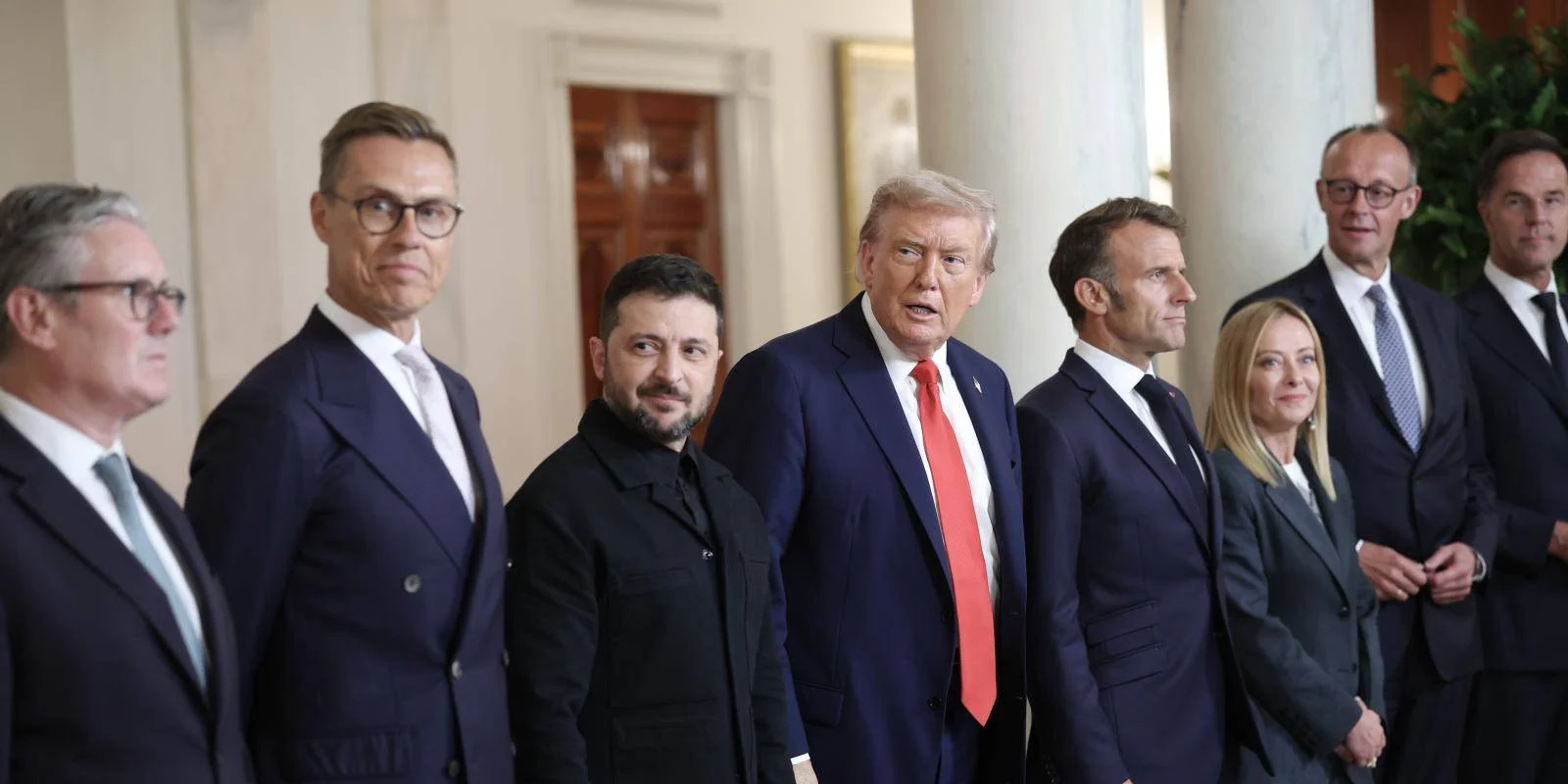
When Volodymyr Zelenskyy walked into the White House couple weeks ago, he did not come alone. At his side stood a striking entourage: French President Emmanuel Macron, German Chancellor Friedrich Merz, British Prime Minister Keir Starmer, Italian Prime Minister Giorgia Meloni, Finnish President Alexander Stubb, along with European Commission President Ursula von der Leyen and NATO Secretary-General Mark Rutte.
The photo op was no accident. It was a carefully constructed display of solidarity — a demonstration that Europe, in its many forms and factions, is prepared to stand shoulder-to-shoulder with Ukraine. With Washington debating the scope of America’s role, Zelenskyy’s escorts reminded all parties that Ukraine’s survival and Europe’s stability are inseparable.
Why these leaders?
- France and Germany: Macron and Merz are Europe’s twin pillars of diplomacy and economic power. Their presence ensured the EU’s voice was heard at the highest levels. Macron has sought to position France as both mediator and defender, while Merz has worked to stabilize Germany’s policy after years of dependence on Moscow.
- Britain: Starmer’s appearance was notable. Only months into office, he has sought to re-anchor the UK’s global role after Brexit, hosting a London summit on Ukraine security guarantees and positioning Britain as an architect of a “coalition of the willing.”
- Italy: Giorgia Meloni brings credibility in Washington. While firmly opposed to Russian aggression, she has cultivated strong ties across the Atlantic and serves as a pragmatic voice bridging U.S. and European perspectives.
- Finland: With a 1,300-kilometer border with Russia, Finland brings urgency as well as solidarity. President Stubb has insisted Finland must help shape European security guarantees, even suggesting peacekeeping roles once conditions allow.
- EU and NATO chiefs: Von der Leyen and Rutte represented the institutions, underscoring that Ukraine’s fight is not only national but continental.
The symbolism and the substance
This group functioned as Zelenskyy’s “protection quad” — not guards with earpieces, but a diplomatic shield. Each leader signalled that Ukraine would not be left to negotiate alone.
Arriving together, the leaders projected unity across Europe’s spectrum — conservative and progressive, EU member and post-Brexit Britain, NATO and EU institutions. They showed Europe is not waiting for Washington to decide its stance. It already has one.
Behind the symbolism lies substance. Projects like the proposed “European Sky Shield” — a joint air defense initiative — show Europe’s willingness to commit resources. Bilateral security pacts signed by London, Paris, Berlin, and others mark a shift from aspirational promises to enforceable commitments. Even discussions of peacekeeping contingents reflect an evolving doctrine: Europe as guarantor, not just commentator.
A new role for Europe
For decades, the United States has been the ultimate guarantor of European security. NATO has relied on U.S. power. But the scene in Washington suggested a new balance: Europe escorted Zelenskyy into the Oval Office as if to say that if America reduces its role, Europe will step forward.
That does not mean Europe can replace the United States. American support remains indispensable, and U.S. leaders are right to expect real burden-sharing. But Europe’s message was clear: Ukraine will not be abandoned, and any settlement that rewards aggression will not be recognized as peace.
For Moscow, the tableau in Washington was as pointed as any communiqué: Ukraine is flanked by Europe’s most powerful leaders and institutions. For U.S. policymakers, the message is equally clear: Europe is prepared to be a true partner in shaping the outcome.
The stakes
In 1994, Ukraine gave up its nuclear arsenal in exchange for “assurances” in the Budapest Memorandum — assurances that collapsed when Russia invaded. The choreography two weeks ago was designed to prevent that mistake from being repeated. Security guarantees must be more than paper promises; they must be backed by hardware, training, and political will.
Zelenskyy’s escorts embodied that will. Their presence was Europe’s way of saying: Ukraine’s fight is our fight. The protection quad — plus Finland, plus the institutions — is the scaffolding of a new European security order.
The exam question in D.C.
The question for Washington is no longer whether Europe will stand with Ukraine — it will. The question is how the United States chooses to partner with a Europe that is finally stepping up.